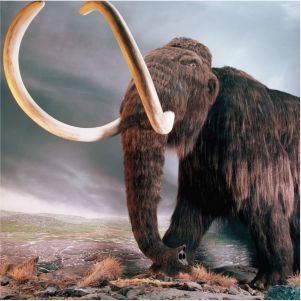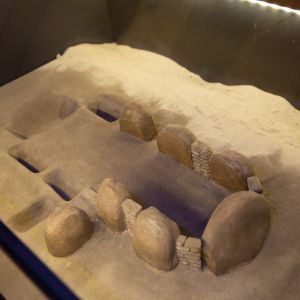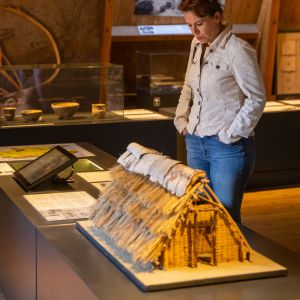
In the OERmuseum, you will embark on a ‘Journey through Time’, from the last Ice Age to the Bronze and Iron Ages. With dioramas, videos and interactive game elements, you will gain a better understanding of who the people were who lived and worked in Drenthe so many years ago. We can divide prehistory into three different periods: the Stone Age, the Bronze Age and the Iron Age.
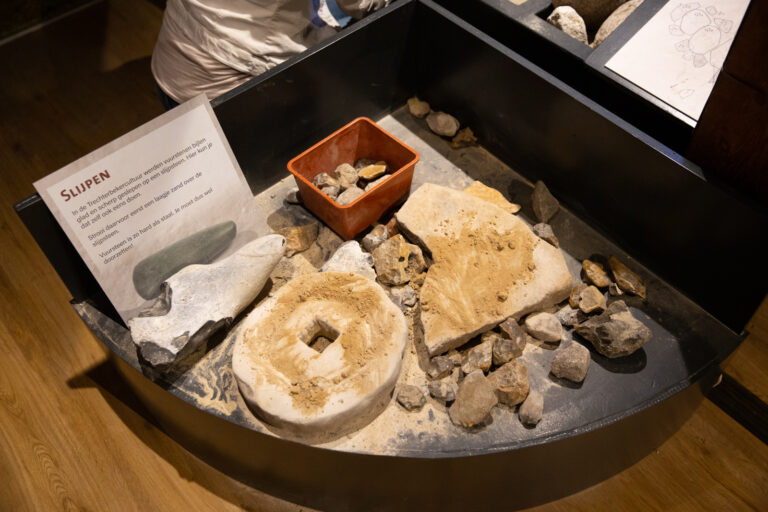
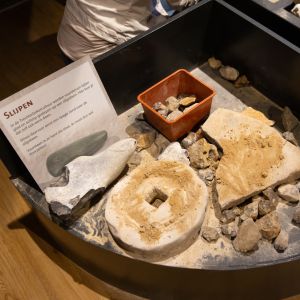
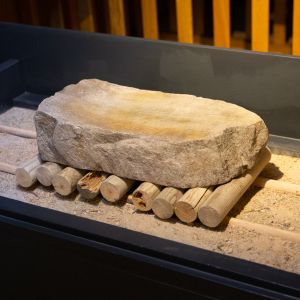
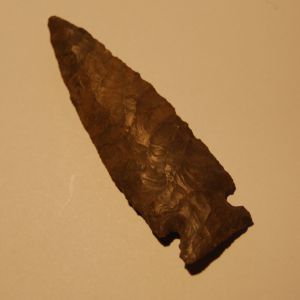
Prehistory literally means before history. It is the time before people wrote down how they lived. Broadly speaking, in the Netherlands this is the time before the year zero. In prehistoric times, people invented trade and fire. They created this fire by using flint. People also made stone tools from these rocks. From bones they made bone tools, such as hammers, axes, needles and tent poles. They used tree branches to weave baskets. Everything we know about prehistory or prehistoric times is based on archaeological finds. Many of the archaeological finds in the OERmuseum were discovered in Diever and the surrounding area.
The earliest traces of humans in the Netherlands are from Neanderthals. The first modern humans, Homo Sapiens, only appeared at the end of the last Ice Age, just before the beginning of the Middle Stone Age. They most likely relied on the many water birds and fish from the numerous streams, lakes and moors. The discoveries and traces of farms suggest that the first farmers moved into the area around 5,300 BC.
The Stone Age is the earliest and longest period of human history. The Stone Age refers to the prehistoric period when people used stone tools, before they started using metal tools. At the very end of the Stone Age however, humans did start making jewellery from some metals.
The Stone Age can be divided into three periods:
In the OERmuseum you will find various artefacts, such as a hand axe from the Stone Age. The objects were discovered in Diever and the surrounding area.
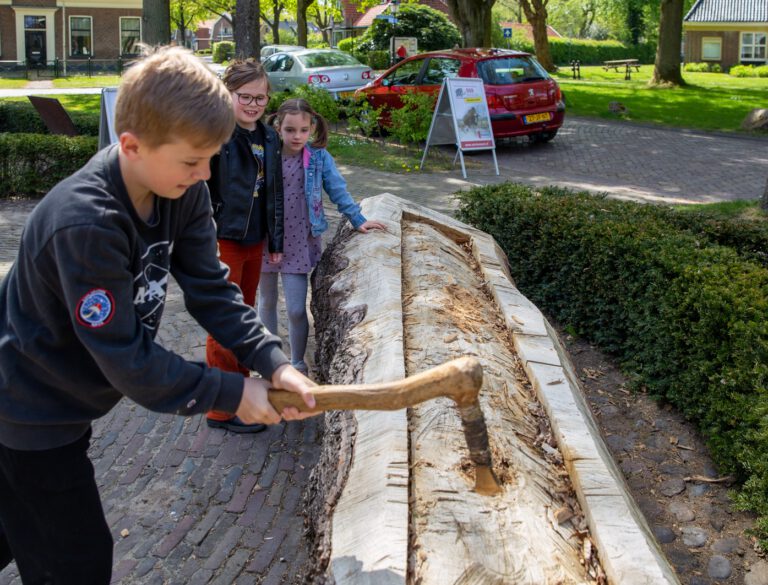
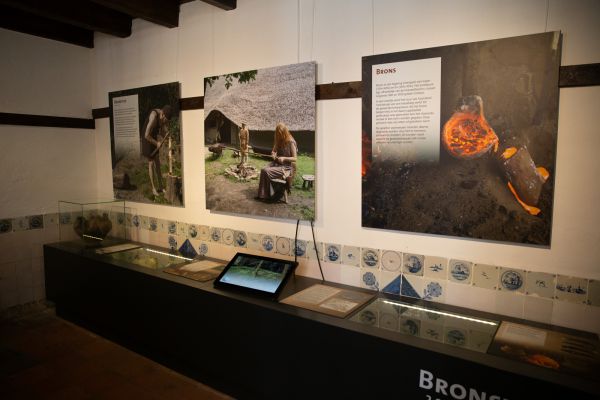
The Bronze Age (approx. 3,200 to 800 BC) follows on from the Stone Age. The knowledge of how to work with metals, including bronze, originated in the Middle East. Over there, bronze had already been in use since around 3,000 BC. This knowledge then gradually spread throughout Europe.
In Central Europe, there is another period between the New Stone Age and the Bronze Age, which is often referred to as the Copper Age. A few copper objects from this period have been found in the Netherlands, but these were quite rare.
Bronze replaced flint as the main material for making tools, weapons and jewellery. However, stone was still used as a tool for a very long time. The oldest surviving objects made of bronze were mainly axes, but they also included some daggers, staff daggers and jewellery such as bracelets. Bronze slowly became more widespread and more types of metal objects came into use.
The Iron Age (approx. 800 to 12 BC) follows the Bronze Age. The Iron Age is the period when people transitioned to using iron to make tools and weapons. Iron has several advantages over bronze. Iron is a much stronger material than bronze and the raw material for iron is found in many more places. It took a long time before people learned how to extract the metal from its ore. The benefits resulted in iron becoming the preferred material for all kinds of weapons (especially swords) and tools. However, bronze remained an important material for jewellery and ornaments (especially bracelets and equestrian equipment).